Or how to continue the war on your own
Two September 1945. Battleship Missouri (an old friend of this blog). Japanese Foreign Minister Mamoru Shigemitsu, along with other Japanese government officials signed the surrender of Japan, under the watchful eye of Douglas MacArthur. Japan, officially, had surrendered to the Allies. But does everyone? No. Not everyone. A series of irreducible Nippon continue the fight on their own, isolated from their comrades in arms. Are zan-ryū scha or Nippon zan-ryū hei, soldiers (from Japan) left behind.
is somewhat difficult to conceive in our minds, but the determination and pride of soldiers led them to continue the fight against the enemy until after thirty years of his country's surrender . Several reasons prompted them to do so, but one stands above the rest: do not believe it would have been possible for Japan to surrender, and all the news reached them about it were branded as American propaganda.

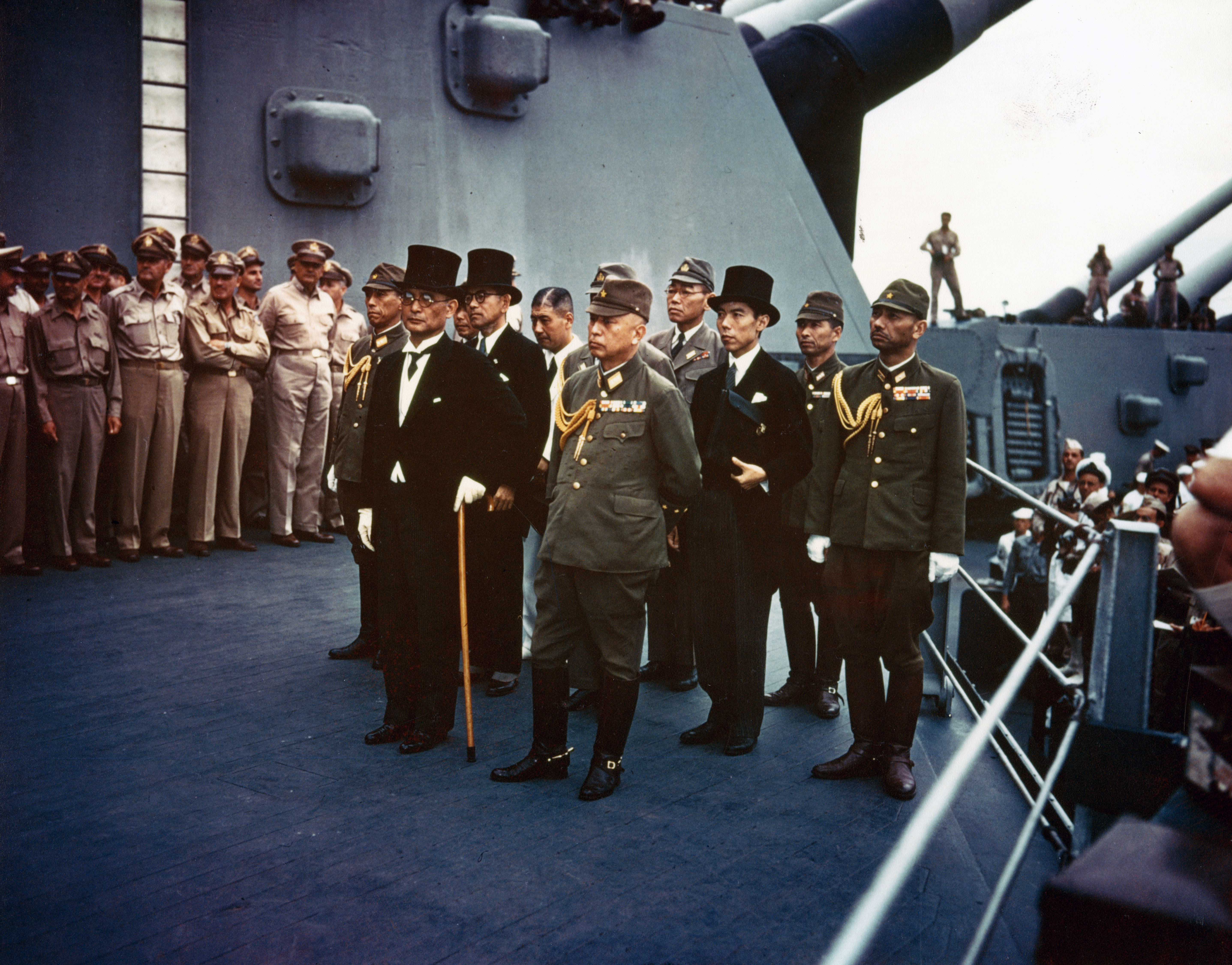
The representation of the Japanese Government in Missouri
Many attempts were unsuccessful, regardless of who came. Some of them are only delivered when the officer ordered him ... Officers took almost thirty years reintegrated into civilian life.
must understand one thing: the Pacific is huge. Simply huge. A vast territory plagued also by thousands of islands, islets, atolls, etc. Only the Philippines and Indonesia have identified 20,000 islands. And are not the only islands. Goes on. The Pacific is full of pieces of land, to make matters worse, they have lush vegetation. It is therefore normal that not hundreds, but thousands of Japanese soldiers are isolated.
turned out to be normal that several groups of Japanese soldiers were held in a kind of concentration camps waiting to be repatriated. Many never were, most did so during 1946 and 1947. But these are people we care today. It is amazing what they did several groups of soldiers who lost contact with their patrol cars or officers, and continued to fight the enemy hiding, surviving as best they could.
Today it is highly unlikely (not impossible) that Japanese holdouts are somewhere in the Philippines. A Japanese octogenarian wielding a rifle and wearing something questionable status at some point in the past was a battle dress? Well, maybe be ... However, there is something I think more importantly, how many more there and not know?
During the early postwar years the emergence of these soldiers created between astonishment and derision. There was no head of the victors that someone had kept fighting for only three to four years, robbing farmers (and the enemy himself) to live and to escape the militia patrols. But it was. Until 1950 these insurgents operating in large groups. For example, the December 1, 1945 forty-six soldiers under the command of Captain Oba surrendered on Saipan; had been harassing U.S. forces, hiding in caves and forests, since the end of the battle that took place on that island, July 9, 1944. In 1946, a division of 120 Japanese soldiers were defeated in the mountains south of Manila, but in April 1947 and still had 4,000 soldiers, of the 140,000 that were isolated in the Philippines, with their whereabouts unknown.

Captain Oba surrenders flag
A string appeared never end.
In the 50 soldiers encounters become more sporadic isolated ... While most surprising result. In particular, about thirty Japanese sailors who were held incommunicado at Anatahan Island in the Marianas. Two reasons make this group special: a gift they fell from heaven and among them was a woman. Hustler year, but survival improved slightly when a B-29 crashed on the island when returning from bombing Nagoya, and, basically, recycled to their advantage: with the metal containers were where to eat and drink, oxygen tanks stored water, with nylon parachutes a clothing, etc. However, the coexistence was not easy. A single woman for many men provoked disputes that were aggravated by abuse of wine from coconut, which is also toxic. So much so that six of the eleven who died in a violent way (with the aircraft came too handguns and machine guns defensive vehicle). And at least four with whom she shared her affection (being thin) were, as stated later, "swallowed by the waters." Tired of this situation, the woman took an oversight and drew attention de un buque estadounidense que patrullaba cerca, y de ese modo fue llevada a Saipán, y comentó a las autoridades que los restantes no creían que la guerra hubiese acabado. En 1951, sólo cuando, aparte de la propaganda, sus propias familias les dijeron que la guerra terminó en 1945, se convencieron y se rindieron.
En 1965 (veinte años después de terminar la guerra), un rezagado fue avistado en la isla de Vella Lavella... Fue descubierto en el jardín de una habitante de la isla. Es decir, mientras se buscaba las castañas tratando de encontrar algo que echarse a la boca entró en dicha parcela. Cuando volvió a Japón, after being convinced by the Ambassador of Japan in Solomon, was received with full honors. No wonder. But it is perhaps the only solo Vella Lavella is said, is discussed, it is rumored that one or two more ... The latest report is from 1989. Awesome.
In Guam, Tadashi Ito Sergeant lasted until 1960. But I was not alone. At your service was Shoichi Yokoi, who fled to the capture until 1972. It was the last survivor of the patrol Tadashi, who went into the jungle to avoid the humiliation of surrender. One by one they surrendered or were killed by marintes. But this man is the movie: as the humidity destroyed his uniform was made with fibers other cocteros, with which was also hammocks, shoes ... Do you know this man what he did before the war? Was a tailor. And that saved his life. No firearms (only officer kept a sword), he learned to hunt small animals with traps, and thus survived only twelve years (plus another fifteen times with other Japanese.) And his capture was the most stupid: hunters followed a trail, and they ran with it. Do not know how to react: a bearded Oriental with some clothes at least strange ... But no resistance was a renegade, but no idiot, four men could not well fed. He also returned to Japan as a hero, but he always had the feeling would not have served as the Emperor.
However, the most famous was Hiroo Onoda, the Japanese penultimate isolated safe on record. Lieutenant Onoda's mission was to harass the Americans through guerilla tactics on the Philippine island of Lubang. His task was reduced to just him and three more soldiers, but they were well trained to become ghosts attack and disappear. The four went crazy for the Filipinos on the island for several years. In 1950 one of the three soldiers was wounded and captured. His handwritten notes in which invited Onoda and his comrades to surrender because the war ended five years ago were not believed. In 1953, in an encounter with a Philippine patrol, another soldier died. There were only Kinshichi Onoda and Kozuka, who died in, the data eye, 1972. Twenty years the two of them survived, while acting (confiscating what they thought was useful, or nosing considered suspicious facilities to serve the enemy). After the death of Kozuka, Onoda was determined to die fighting, not going to give up, because even almost thirty years later did not believe in the surrender of Japan. But believe it ended when it was found in March 1974 by a student who had proposed just that, finding Lt. Onoda. And when he did, he told her she would not give up ever, unless it receives the order from his superior. And this was now a respectable bookseller, in disbelief, he traveled to the Philippines to liberate their orders Onoda. The lieutenant surrendered to Philippine authorities, handed his sword, his rifle and everything he and his men seized the enemy in those years. The Philippine president pardoned him for what he and his soldiers did in those thirty years and returned Japan, you know how? Exactly, as a hero. And they profited from it: he wrote the best-seller "No surrender: my thirty year war."

Hiroo Onoda, at the time of surrender (finally!)
But was not the last ... Teruo Nakamura appeared in Indonesia in December 1974. This is officially the last hei Nippon zan-ryū although Ishinosuke Uwano was later discovered ... But cheated: he was captured by the Soviet army, fled and not camouflaged in the jungle, like this, but in Ukraine, forming his own family.
Finally, a false rumor appeared in 2005, two Japanese soldiers of World War II were delivered in Mindanao, Philippines. Were said to be Yoshio Yamakawa, 87, and Tsuzuki Nakauchi, 85. But it turned out to be a fraud. Apparently, did not attend the meeting they agreed with the authorities and nothing more was heard of them. It would have been epic, yes ...


0 comments:
Post a Comment